Vendors use “chatbot”, “assistant”, “copilot” and “agent” loosely, and the same product can be described with all four. There is no single industry definition that cleanly separates them. Anthropic’s guide to building effective agents notes that some people use “agent” for fully autonomous systems and others for more prescriptive implementations that follow predefined workflows.
For a business deciding what to build, a more useful question is: who decides the next step, and what can the software change?
Three useful patterns
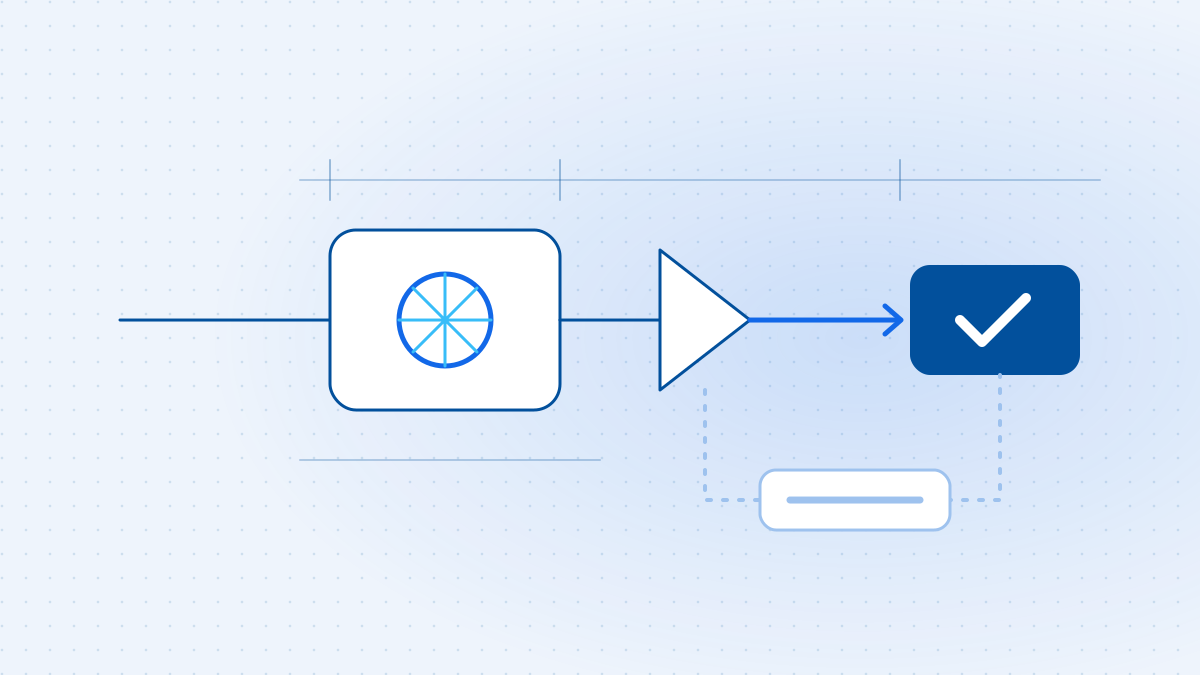
Deterministic workflow automation. The steps are defined in advance. When an invoice arrives, extract its fields, match it to the purchase order, and route it for approval if it exceeds a threshold. Rules decide every branch. There may be no AI at all, or AI may handle one step, such as reading a scanned document, inside a fixed process. It is predictable, testable and inexpensive to run.
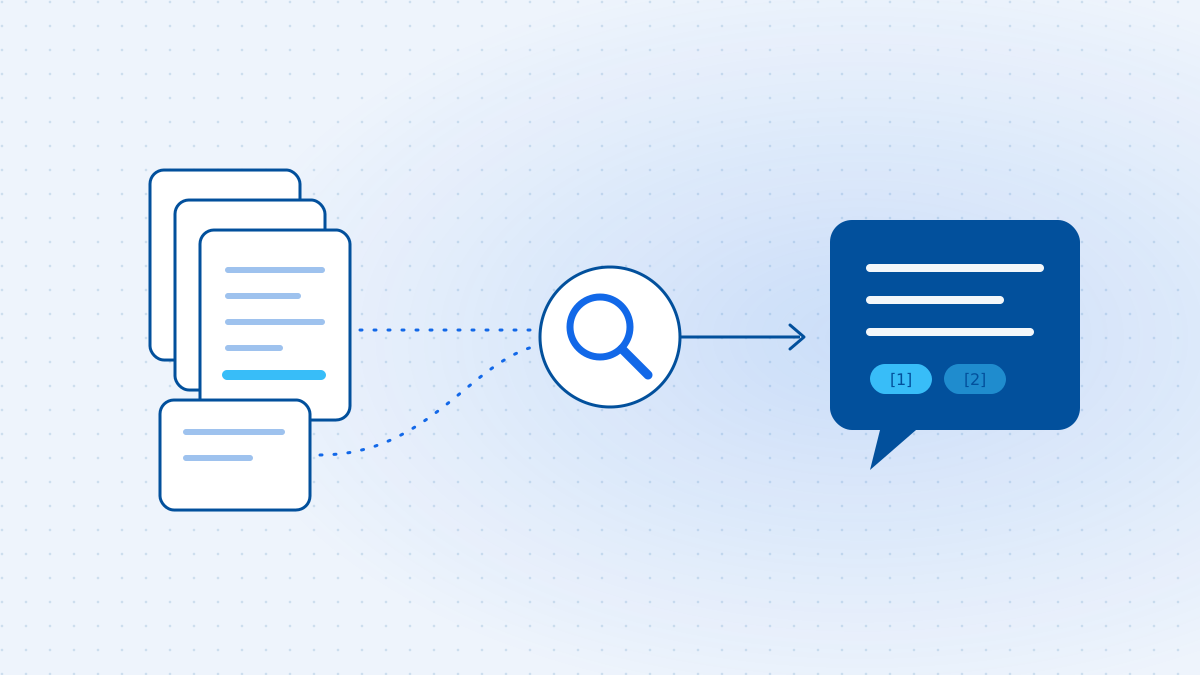
Conversational assistant. It responds to a person: answering questions, drafting text, summarizing. It may retrieve information or call read-only tools, but the person stays in control of what happens next.
Agent. Within limits, the model decides which steps to take and which tools to call to reach a goal, looks at the results, and continues until it finishes or needs help. Anthropic draws the line between workflows, where models and tools are orchestrated through predefined code paths, and agents, where the model directs its own process.
These are points on a spectrum, and many good systems combine them: a fixed workflow with one AI step, or an assistant that can call two carefully scoped tools.
A hypothetical example
A logistics company wants to reduce the time spent on delivery-exception emails: damaged parcels, wrong addresses, refused deliveries.
- A workflow approach classifies each email into a known category, extracts the shipment number, looks up the shipment and creates the right ticket with a templated reply for a person to send. Every branch is visible and auditable.
- An assistant approach gives support staff a panel that summarizes the thread, pulls shipment history and drafts a reply they edit.
- An agent approach lets the model read the email, decide which systems to query, rebook the delivery and reply to the customer itself.
For most teams the first two are the sensible starting point. The categories are known, and actions such as rebooking or refunds have real consequences. An agent becomes worth considering only when the variety of cases genuinely can’t be captured in rules and the available actions can be safely bounded.
Implementation considerations
- Start with the simplest thing that works. Anthropic recommends finding the simplest solution possible and adding complexity only when needed, noting that agentic systems often trade latency and cost for better task performance.
- Bound tool permissions. OWASP lists excessive agency as a top risk for LLM applications: tools with more functionality or permissions than the task needs. Give each tool the narrowest scope, read-only where possible, and specific operations rather than general database or email access.
- Require human approval for consequential actions. OWASP recommends human-in-the-loop approval for high-impact actions. Refunds, outbound customer messages and changes to financial records are obvious candidates.
- Log and monitor. Record each step, tool call and input, so failures can be investigated and behaviour reviewed over time.
- Plan for failure. Decide what happens when a tool call fails, the model’s output doesn’t parse, or the case is unclear. Usually that means a hand-off to a person with the context attached, not a silent retry loop.
- Evaluate on realistic cases. Test against a set of real, anonymized examples, including awkward ones, before and after every change.
Trade-offs
Workflows are cheaper per run, faster and easier to test, but rigid: new case types need new rules. Assistants are flexible and keep people in charge, but save less time on high-volume work. Agents can handle more varied tasks, but a single run may involve many model calls, so cost and latency are less predictable. Anthropic notes that the autonomy of agents means higher costs and the potential for compounding errors, and recommends extensive testing in sandboxed environments with appropriate guardrails.
None of these is “more advanced” in a way that matters to your business. The right choice depends on how variable the work is, how costly a mistake would be, and how much oversight you can provide.
A practical rule of thumb
If you can draw the process as a flowchart, automate the flowchart and use AI only where a step needs judgement about unstructured input. Reach for an agent when the path genuinely can’t be drawn in advance and the actions available to it can be tightly limited.
If you’re deciding between these approaches for a specific process, we can help you map it and choose the least complex option that does the job.